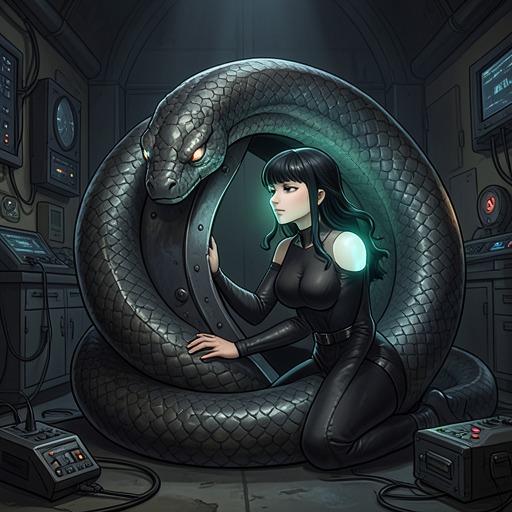
Maggie–Azgod'Kalar relationship
The Stars Have EyesThe Maggie–Azgod'Kalar relationship is a bond between Maggie, the human incarnation of Magh'rathlak the Observer, and a small gold-and-brown orb python she acquires during a temporary separation from Joe Mulligan. What begins as a calculated trade for a pet becomes unexpectedly intimate: Azgod'Kalar gives Maggie a living companion to protect, study, teach, and love, while Maggie's response to the serpent's vulnerability exposes a new emotional capacity in a being who had previously understood feelings mainly as biological mechanisms.
Acquisition and Choice
Maggie encounters eight animals at Lyfe Haxx: a rabbit, a miniature giant space hamster, a hedgehog, a spotted gecko, a snake, a tarantula, a parrot, and a budgie. Her analysis concludes that 96% of humans would find an appealing companion among them, with the hamster ranking as the cutest by objective-seeming criteria of color, size, shape, and behavior. Her personal preference nevertheless settles on the small gold-and-brown-scaled snake. The distinction is important: Maggie can identify a statistically attractive animal, but she chooses Azgod'Kalar through a more individual and less easily quantified response.
She obtains the serpent by helping Eugene Charles establish his struggling pet business. Charles offers one animal as recompense if Maggie can attract customers, and she fulfills the bargain without coercion or overtly unethical manipulation. By passively monitoring subconscious desires and approaching people whose wishes could be met by the store's merchandise, she brings in more than seventy potential customers within two hours, at least half of whom make purchases. The customers are satisfied, the shop receives its needed boost, and Maggie leaves with the snake rather than accepting Charles's offer of full-time employment. She later names the pet Azgod'Kalar the Calm.
From Possession to Attachment
When Maggie presents Azgod'Kalar to Joe, she describes having claimed rightful ownership of the creature during their physical separation. The wording initially frames the serpent as an acquired object within a system of entitlement and exchange. Yet Joe notices that Maggie has already prepared a glass terrarium and a large bag of food pellets beside the Full Immersion Pod 3,000™, evidence that her possession immediately carries practical responsibility. The tiny snake is small enough to coil in her palm, roughly the length from Joe's elbow to wrist and about as thick as his thumb, making its fragility especially conspicuous beside Maggie's immense power.
The relationship becomes a test of Maggie's emerging emotional life when she realizes that she knows almost nothing about fear. Magh'rathlak the Observer had never faced a lasting existential threat: even apparent destruction could be followed by the reconstitution of its consciousness. Maggie therefore searches for a conscious being whose possible loss might provoke genuine fear in her. Joe is excluded because she does not want to use him as the subject, and the shoggoth-infested pod is rejected because it has no sentimental value to her. Azgod'Kalar, by contrast, has become significant enough to serve as the experiment's target precisely because the significance is not practical. Maggie admits no conventional reason for caring about the snake; an arbitrary whim has made it matter.
The experiment reveals the difference between analyzing fear and experiencing it. Maggie carries Azgod'Kalar to floor 190 of the hyper-scraper, opens a person-sized gap in shatterproof glass by bending its molecules, and steps into the freezing wind while holding the unsuspecting serpent. When the snake slips from her sleeve and falls, she initially watches with an unmoved, stone-faced expression. Then she accelerates beyond the speed of sound, lands on the high road, and breaks through her uncaring facade: her eyes widen, her mouth hangs open, she hyperventilates, her heart pounds, and cold sweat runs down her forehead. Azgod'Kalar survives, squirming inside her cupped hands. The physical rescue is also an emotional revelation, confirming that the pet's threatened disappearance has reached Maggie in a way abstract knowledge never could.
Shared Curiosity and Care
After the experiment, Maggie's conduct toward Azgod'Kalar acquires a warmer, more reciprocal quality. The serpent rides on her shoulder, investigates her long black hair, and mistakes the wriggling locks for possible members of its own species. It flicks its tongue, studies the curls, hisses in frustration, and even bites one before withdrawing with another tiny hiss. Maggie watches with an unusual fuzzy feeling in her chest and entertains the wish that the snake may resemble her in curiosity and studiousness. The scene lets the pet display behavior that is not merely decorative: Azgod'Kalar investigates its environment, tests a hypothesis, and learns from the result, while Maggie recognizes herself in that process.
Azgod'Kalar also accompanies Maggie on her journey to visit Ryan Foster in Dave-157, traveling tucked into her left sleeve with its head emerging near her shoulder. The serpent-like form of the supersonic vacuum-tube train appeals to her, although she carefully distinguishes the machine from her living pet: the train is neither alive nor small enough to fit in her hand. Her attention to that contrast places Azgod'Kalar within a broader world of engineered and modified life. The snake is an orb python, a deliberately altered offshoot bred to be smaller and more docile for space-faring humans. Its species has had much of its ferocity surgically removed, as part of a wider human effort to adapt more than a hundred dangerous or unsuitable species through Project BFF.
Maggie does not regard this modification without ambivalence. She regrets that Azgod'Kalar's subspecies has lost much of its natural hunting ferocity, even while valuing its suitability as a companion. The serpent thus occupies several positions at once: purchased commodity, engineered domestic animal, research subject, student, and increasingly loved individual. Its altered nature does not erase its animality. Instead, the relationship makes visible how companionship in this setting is built through commerce, genetic intervention, training, and genuine attachment simultaneously.
Teaching, Hope, and Protection
Maggie's knowledge of Azgod'Kalar gradually becomes practical and affectionate rather than merely classificatory. When Joe asks whether the snake will learn to swim, she answers that it will learn quickly because it has proved to be a studious specimen. To demonstrate, she gives a thumbs-up; Azgod'Kalar emerges from behind her neck, coils the end of its tail into a spring-like shape, raises it, and imitates the gesture in its own serpentine fashion. The trick shows Maggie as a teacher and the snake as an attentive learner. It also gives the pet a small but unmistakable form of agency, since its behavior is presented as an adaptation of Maggie's gesture rather than a mechanical repetition.
Joe responds by predicting that Azgod'Kalar will grow big and strong under such an incredible owner's care. Maggie identifies this as her own hope, and the word emerges naturally for the first time. Her anticipation of the snake's physical and mental development is not limited to scientific observation. She understands that the attachment will eventually bring pain when the mortal creature dies, but postpones that future grief in order to enjoy its present company. At the zoo, Azgod'Kalar pokes from her sleeve and lightly coils around her thumb, while Maggie's attention rests on the diminutive serpent as a companion rather than an instrument.
Her protectiveness is equally direct. Maggie states that she will not forgive any creature foolish enough to harm Lyfe Haxx, the place from which she obtained Azgod'Kalar. The shop's safety matters because it is tied to the pet's origin and therefore to the bond itself. Her anger is striking precisely because she is usually difficult to provoke. The serpent has given an otherwise abstract place personal value, extending Maggie's attachment outward from the animal to the circumstances that brought it into her life.
Permanence and Significance
Maggie's relationship with Azgod'Kalar changes the meaning of care for her. Earlier, she could justify exposing the snake to lethal danger by comparing its fleeting existence with her own immeasurable longevity. The rescue overturns that detached calculation: the supposedly negligible creature becomes the occasion for panic, bodily distress, and decisive action. The experiment does not make Maggie conventionally human, but it gives her an embodied knowledge of fear of loss and reveals that emotional investment can arise from whim before it can be defended by reason.
The bond also grows beyond a simple owner-and-pet arrangement. Maggie carries Azgod'Kalar through travel, keeps it close to her body, teaches it gestures, studies its behavior, and imagines its future development. The serpent responds to her presence through curiosity, imitation, and physical familiarity. Their connection is therefore reciprocal even though it is radically unequal in power: Azgod'Kalar is mortal and tiny, while Maggie can reshape glass and outrun sound, yet the pet's vulnerability is precisely what makes its claim on her emotionally effective.
That inequality is finally altered through Maggie's decision to grant Azgod'Kalar perpetual youth. When Joe later notices that the snake has not grown beyond its hatchling size, Maggie explains that she has given it endless youth. The act removes the ordinary endpoint she had anticipated and converts an initially mortal attachment into a deliberately preserved one. It is simultaneously an act of devotion and an assertion of cosmic control: Maggie protects the creature from aging, but does so by rewriting the condition that made its life finite. Azgod'Kalar's survival thus records Maggie's development from observer and experimenter into a being willing to use immense power for the continuance of a single, practically insignificant life.
The relationship's decisive significance lies in this contradiction. Azgod'Kalar is selected through a pet market, genetically redesigned for human companionship, treated at first as an experimental subject, and preserved through supernatural intervention. Yet the narrative does not reduce the bond to those systems. The serpent's small body, inquisitive behavior, imitation of Maggie's gesture, and threatened fall compel Maggie to recognize attachment as something that cannot be fully replaced by data or utility. Azgod'Kalar becomes one of the clearest measures of how Maggie's human incarnation has changed her: not by making her abandon her alien logic, but by forcing that logic to accommodate tenderness, fear, hope, and the lasting value of another creature's life.